<?xml version="1.0" encoding="iso-8859-1"?>
<feed version="0.3" xmlns="http://purl.org/atom/ns#" xmlns:dc="http://purl.org/dc/elements/1.1/" xml:lang="en">
  <title>River of Dreams</title>
  <link rel="alternate" type="text/html" href="http://www.dougsimpson.com/river/" />
  <modified>2005-06-16T09:41:48Z</modified>
  <tagline>Doug Simpson&apos;s web log of the geography, culture and people of the Connecticut River Valley.</tagline>
  <id>tag:www.dougsimpson.com,2005:/river/4</id>
  <generator url="http://www.movabletype.org/" version="3.15">Movable Type</generator>
  <copyright>Copyright (c) 2005, dougsimpson</copyright>
  <entry>
    <title>Digital Deerfield</title>
    <link rel="alternate" type="text/html" href="http://www.dougsimpson.com/river/archives/000416.html" />
    <modified>2005-06-16T09:41:48Z</modified>
    <issued>2005-06-16T04:34:28-05:00</issued>
    <id>tag:www.dougsimpson.com,2005:/river/4.416</id>
    <created>2005-06-16T09:34:28Z</created>
    <summary type="text/plain">Digital Deerfield 1704: A new perspective on the French and Indian Wars by Lynne Spichiger and Chris Sturm http://firstmonday.org/issues/issue10_6/spichiger/ Abstract: In February 2003, on the 300th anniversary of the raid on Deerfield, the Pocumtuck Valley Memorial Association and the Memorial...</summary>
    <author>
      <name>dougsimpson</name>
      <url>dougsimpson.com</url>
      <email>douginhartford@earthlink.net</email>
    </author>
    <dc:subject>Colonial Era</dc:subject>
    <content type="text/html" mode="escaped" xml:lang="en" xml:base="http://www.dougsimpson.com/river/">
      <![CDATA[<p>Digital Deerfield 1704: A new perspective on the French and Indian Wars<br />
by Lynne Spichiger and Chris Sturm<br />
http://firstmonday.org/issues/issue10_6/spichiger/</p>

<p>Abstract:</p>

<p>In February 2003, on the 300th anniversary of the raid on Deerfield, the Pocumtuck Valley Memorial Association and the Memorial Hall Museum launched a Web site that both commemorates and reinterprets this event from the perspectives of all the cultural groups who were present: Wobanakiak, Kanienkehaka, Wendat, English, and French. The site brings together a multitude of Web elements including historical scenes, narratives of peoples' lives, artifacts and historic documents, interactive maps, voices and songs, essays, illustrations/paintings, and an interactive timeline to provide a window into a world of global political and religious conflict, family stories, and military sagas. Many teachers find that this site - with its wealth of primary source material; its special features like interactive maps and artifacts, zoom function, and magic lens; and its curricula section - is an excellent digital resource for their classrooms.</p>

<p>Story about Digital Deerfield as a teaching tool:  <a title="Digital Deerfield 1704" href="http://firstmonday.org/issues/issue10_6/spichiger/">Digital Deerfield 1704</a></p>

<p>Digital Deerfield site: <a title="Raid on Deerfield: the Many Stories of 1704" href="http://www.1704.deerfield.history.museum/">Raid on Deerfield: the Many Stories of 1704</a></p>

<p><br />
<a href="http://DougSimpson.com/river">DougSimpson.com/river</a></p>]]>
      
    </content>
  </entry>
  <entry>
    <title>Silas Deane lives ... online</title>
    <link rel="alternate" type="text/html" href="http://www.dougsimpson.com/river/archives/000372.html" />
    <modified>2005-02-07T00:24:49Z</modified>
    <issued>2005-02-06T18:01:31-05:00</issued>
    <id>tag:www.dougsimpson.com,2005:/river/4.372</id>
    <created>2005-02-06T23:01:31Z</created>
    <summary type="text/plain">A contemporary of Adams and Washington, Silas Deane (Yale 1758) came to the bar in Hartford in 1761 and settled in Wethersfield. During the Revolution, he served in the first Continental Congress and went to France where he recruited Lafayette....</summary>
    <author>
      <name>dougsimpson</name>
      <url>dougsimpson.com</url>
      <email>douginhartford@earthlink.net</email>
    </author>
    <dc:subject>U.S. Revolution</dc:subject>
    <content type="text/html" mode="escaped" xml:lang="en" xml:base="http://www.dougsimpson.com/river/">
      <![CDATA[<p>A contemporary of Adams and Washington, Silas Deane (Yale 1758) came to the bar in Hartford in 1761 and settled in Wethersfield.   During the Revolution, he served in the first Continental Congress and went to France where he recruited Lafayette.  Charged with treason  by John Adams and John Jay for alleged financial misdeeds, he died in 1789.</p>

<p>His controversial life is memorialized in  <a title="Silas Deane Online" href="http://silasdeaneonline.org/how.htm">Silas Deane Online</a>, which includes a virtual tour of his home in Wethersfield, Connecticut.  Styled as an educational aid for high school students and teachers, the site has been professionally designed by <a href="http://www.literae.com/">Literae Interactive</a> with funds from the <a href="http://www.imls.gov/">Institute of Museum and Library Services.</a></p>

<p><a href="http://dougsimpson.com/river">DougSimpson.com/river</a></p>]]>
      
    </content>
  </entry>
  <entry>
    <title>Connecticut River Mariners Trans-Sahara Survival Trek</title>
    <link rel="alternate" type="text/html" href="http://www.dougsimpson.com/river/archives/000299.html" />
    <modified>2005-02-01T16:49:30Z</modified>
    <issued>2004-03-20T10:16:06-05:00</issued>
    <id>tag:www.dougsimpson.com,2004:/river/4.299</id>
    <created>2004-03-20T15:16:06Z</created>
    <summary type="text/plain">1815: the brig Commerce sailed down the Connecticut River and across the Atlantic. Wrecked on the coast of Africa, its captain and crew were captured, enslaved by nomads and forced across 800 miles of the Sahara Desert. 13 survived, including...</summary>
    <author>
      <name>dougsimpson</name>
      <url>dougsimpson.com</url>
      <email>douginhartford@earthlink.net</email>
    </author>
    <dc:subject>Maritime History</dc:subject>
    <content type="text/html" mode="escaped" xml:lang="en" xml:base="http://www.dougsimpson.com/river/">
      <![CDATA[<p>1815: the brig Commerce sailed down the Connecticut River and across the Atlantic. Wrecked on the coast of Africa, its captain and crew were captured, enslaved by nomads and forced across 800 miles of the Sahara Desert.  13 survived, including Capt. James Riley of Cromwell, whose account, "<a href="http://www.amazon.com/exec/obidos/ASIN/1585740802/dougsimpson-20">Sufferings in Africa: The Astonishing Account of a New England Sea Captain Enslaved by North African Arabs</a>"  was a best seller at the time.  Built in Keeney Cove in Glastonbury and part owned by Wethersfield's Justis Riley, it was one of thousands of ships built along the river in the age of sail. </p>

<p>Dean King's new book, "<a href="http://www.amazon.com/exec/obidos/ASIN/0316835145/dougsimpson-20">Skeletons of the Zahara: A True Story of Survival</a>," (Little Brown, 2004) includes the results of his own original research and visit to the site of the wreck and retracing of part of the route on which the crew was taken.  </p>

<p>Author King will speak and sign first editions of his book in the Keeney Cultural Center, <a href="http://www.wethhist.org">Wethersfield Historical Society </a>(200 Main Street) Monday, March 20, 2004 at 7:30 PM.   </p>

<p>For more info and photos see: <a title="ctnow.com - LIFESTYLE" href="http://www.ctnow.com/features/lifestyle/hc-skeletons.artmar18,0,4883499.story">"Sands Of Suffering"</a> (Hartford Courant 3/18/04 p. D1)</p>

<p>See also a review at: "<a href="http://www.sfgate.com/cgi-bin/article.cgi?f=/c/a/2004/02/22/RVGU34VJSE1.DTL">Into the Fire</a>,"  SFGate.com (2/2204)</p>

<p><a href="http://DougSimpson.com/river">River of Dreams</a><br />
at DougSimpson.com</p>]]>
      
    </content>
  </entry>
  <entry>
    <title>Birth of the American Furniture Style in &quot;Woodworkers of Windsor&quot;</title>
    <link rel="alternate" type="text/html" href="http://www.dougsimpson.com/river/archives/000294.html" />
    <modified>2005-02-01T16:49:30Z</modified>
    <issued>2004-03-18T08:56:40-05:00</issued>
    <id>tag:www.dougsimpson.com,2004:/river/4.294</id>
    <created>2004-03-18T13:56:40Z</created>
    <summary type="text/plain">From 17th Century New England emerged a distinctive style of furniture manufacture. The community of crafters in Windsor, Wethersfield and other early setlements along the Connecticut River took advantage of virgin hardwood forests, plentiful waterpower and the shortage of furniture...</summary>
    <author>
      <name>dougsimpson</name>
      <url>dougsimpson.com</url>
      <email>douginhartford@earthlink.net</email>
    </author>
    <dc:subject>Social Networks</dc:subject>
    <content type="text/html" mode="escaped" xml:lang="en" xml:base="http://www.dougsimpson.com/river/">
      <![CDATA[<p>From 17th Century New England emerged a distinctive style of furniture manufacture.  The community of crafters in Windsor, Wethersfield and other early setlements along the Connecticut River took advantage of virgin hardwood forests, plentiful waterpower and the shortage of furniture in the expanding colonies.  </p>

<p>The Windsor Historical Society hosts an exhibit of furniture made there before 1715.  Organized by Historic Deerfield and funded by the <a href="http://www.cthum.org/chc/CHDFGrants.htm">Connecticut Humanities Council</a> , the exhibit highlights not only the furniture itself, but the social history of how the community of crafters became prosperous, arranged advantageous marriages among the the families of other crafters and dominated local politics of the time. <b> (Read more ... )</b></p>]]>
      <![CDATA[<p>"<a href="http://www.ctnow.com/features/lifestyle/hc-windsorfurniture.artmar13,0,1229641.story">Unmistakably Windsor</a>," (Hartford Courant, 3/13/04) illuminates the important role artisans played in the early community-building efforts of Connecticut's first English town.  Joshua W. Lane, a furniture curator at Historic Deerfield, told the Courant that though Windsor's population was only 35% woodworkers, they held 61% of all town offices and  71% of the sons of first-generation woodworkers in Windsor married woodworkers' daughters.   This enabled the workworkers to develop support networks, furthering their economic and political influence and power.</p>

<p>The Woodworkers of Windsor: A Community of Craftsmen, 1635-1715, continues through April 15 at the historical society, 96 Palisado Ave. (Route 159), Windsor, CT. Admission is $3. For information, call (860) 688-3813. </p>

<p>Photos of some of the furniture are at: "<a href="http://www.ctnow.com/entertainment/attractions/hc-previewct-windsorstyle,1,2051755.htmlstory?coll=hc-ent-headlines-breaking">The Windsor Style: Connecticut's first town was the furniture fashion center of the 17th century</a>" (Preview Connecticut, 1/24/04)</p>

<p>See also: <a title="Windsor Journal" href="http://www.zwire.com/site/news.cfm?newsid=10888510&BRD=1633&PAG=461&dept_id=11608&rfi=6">"Exhibition Explores Puritan Furniture and Life"</a> Windsor Journal (1/29/04)</p>

<p><a href="http://dougsimpson.com/river">Doug Simpson's "River of Dreams"</a></p>]]>
    </content>
  </entry>
  <entry>
    <title>Bald eagles wintering on the lower Connecticut</title>
    <link rel="alternate" type="text/html" href="http://www.dougsimpson.com/river/archives/000276.html" />
    <modified>2005-02-01T16:49:30Z</modified>
    <issued>2004-02-23T12:59:18-05:00</issued>
    <id>tag:www.dougsimpson.com,2004:/river/4.276</id>
    <created>2004-02-23T17:59:18Z</created>
    <summary type="text/plain">Restoration of bald eagles to the Connecticut River was celebrated at the Audubon Eagle Festival at Essex on Feb. 12. As many as 80 birds have been spotted on cruises of the lower river, which has &quot;the largest concentration of...</summary>
    <author>
      <name>dougsimpson</name>
      <url>dougsimpson.com</url>
      <email>douginhartford@earthlink.net</email>
    </author>
    <dc:subject>Wildlife</dc:subject>
    <content type="text/html" mode="escaped" xml:lang="en" xml:base="http://www.dougsimpson.com/river/">
      <![CDATA[<p>Restoration of bald eagles to the Connecticut River was celebrated at the <a href="http://www.ctaudubon.org/eagle.htm ">Audubon Eagle Festival </a>at Essex on Feb. 12.  As many as 80 birds have been spotted on cruises of the lower river, which has  "the largest concentration of wintering eagles, including bald and Golden, in the Northeast," according to Connecticut Audubon Society reports to the Associated Press. Source: <a title="Newsday.com" href="http://www.newsday.com/news/local/wire/ny-bc-ct--eaglefestival0212feb12,0,2581391.story?coll=ny-ap-regional-wire">Newsday.com</a></p>

<p>2003 CT River Eagle Festival Photos in Connecticut Audubon's <a href="http://www.ctaudubon.org/gallery/gallery.htm">Gallery</a></p>

<p>Cold weather has forced eagles from northern parts of the Connecticut, <a href="http://www.zwire.com/site/news.cfm?BRD=1349&dept_id=415622&newsid=10940059&PAG=461&rfi=9">Housatonic</a> and  Naugatuck River valleys to open water along the Long Island shore. New Haven Register, "<a href="http://www.zwire.com/site/news.cfm?BRD=1281&dept_id=517514&newsid=10901508&PAG=461&rfi=9">Cold spell brings hungry bald eagles to area</a>."</p>

<p><a href="http://DougSimpson.com/river">DougSimpson.com/river</a></p>]]>
      
    </content>
  </entry>
  <entry>
    <title>River Art at the Griswold Museum</title>
    <link rel="alternate" type="text/html" href="http://www.dougsimpson.com/river/archives/000203.html" />
    <modified>2005-02-01T16:49:30Z</modified>
    <issued>2003-11-24T05:46:55-05:00</issued>
    <id>tag:www.dougsimpson.com,2003:/river/4.203</id>
    <created>2003-11-24T10:46:55Z</created>
    <summary type="text/plain">The American River celebrates views of the Connecticut and other rivers selected by nationally recognized curators. On display until January 4, 2004 at the Florence Griswold Museum in Old Lyme, Connecticut, will be 50 works of art juried by Carl...</summary>
    <author>
      <name>dougsimpson</name>
      <url>dougsimpson.com</url>
      <email>douginhartford@earthlink.net</email>
    </author>
    <dc:subject>Arts</dc:subject>
    <content type="text/html" mode="escaped" xml:lang="en" xml:base="http://www.dougsimpson.com/river/">
      <![CDATA[<p><a title="The Florence Griswold Museum Exhibitions" href="http://www.flogris.org/exhibitions/Rivers02.html">The American River</a> celebrates views of the Connecticut and other rivers selected by nationally recognized curators.  On display until January 4, 2004 at the <a href="http://www.flogris.org">Florence Griswold Museum </a>in Old Lyme, Connecticut, will be 50 works of art juried by Carl Beltz, Director Emeritus of the Rose Museum; Jeffrey Rosenheim, Curator of Photography from the Metropolitan Museum of Art in New York; and Linda Simmons, Curator Emeritus of the Corcoran Gallery of Fine Art in Washington, DC.  Organized by the <a href="http://www.greatriverarts.org/">Great River Arts Institute</a> of Bellows Falls, VT (formerly of Walpole, New Hampshire), the exhibit was<a href="http://www.greatriverarts.org/mainpages/am_artist.htm"> reviewed </a>by <a href="http://www.myamericanartist.com/americanartist/index.jsp">American Artist</a> Magazine.</p>

<p><img src="http://www.flogris.org/exhibitions/exhibitionsimages/Hannock.jpg"><br />
Stephen Hannock, The Oxbow, After Church, After Cole, Flooded, 1994</p>

<p>Accompanying this exhibition of contemporary works, Florence Griswold Museum also presents an exhibition of river views from its own and others' collections called "The River’s Course: Views of Connecticut Rivers."  This includes 27 works that explore the cultural, historical and social significance of the Connecticut, Farmington, Mystic, Thames, Lieutenant, and West rivers. </p>

<p>During the early years of the last century, Florence Griswold's boarding house in Old Lyme became the center of the <a href="http://www.flogris.org/thestory/lymeart.html">Lyme Art Colony</a>, noted for its depiction of the landscape around this quiet and scenic coastal village between New York and Boston.  The <a href="http://www.flogris.org/visiting/florencegriswoldhouse.html">Griswold House</a>, built in 1817, where a succession of artists lived and painted together, is now a National Historic Landmark and a home of American Impressionism. </p>

<p><a href="http://DougSimpson.com/river">DougSimpson.com/river</a></p>]]>
      
    </content>
  </entry>
  <entry>
    <title>&quot;House of Hope&quot; and &quot;Coltsville&quot;</title>
    <link rel="alternate" type="text/html" href="http://www.dougsimpson.com/river/archives/000170.html" />
    <modified>2005-02-01T16:49:30Z</modified>
    <issued>2003-10-15T15:07:16-05:00</issued>
    <id>tag:www.dougsimpson.com,2003:/river/4.170</id>
    <created>2003-10-15T20:07:16Z</created>
    <summary type="text/plain">1633: the Dutch sent Jacob van Curler up the river to establish a fort near the head of navigation. They called it &quot;Huys de Hoop&quot; - Fort Hope, or the House of Hope. The tiny garrison could not stop English...</summary>
    <author>
      <name>dougsimpson</name>
      <url>dougsimpson.com</url>
      <email>douginhartford@earthlink.net</email>
    </author>
    <dc:subject>Hartford</dc:subject>
    <content type="text/html" mode="escaped" xml:lang="en" xml:base="http://www.dougsimpson.com/river/">
      <![CDATA[<p>1633: the Dutch sent Jacob van Curler up the river to establish a fort near the head of navigation.  They called it "Huys de Hoop" - Fort Hope, or the House of Hope.  The tiny garrison could not stop English settlements and farms around it, and the English were pushing southwest from Massachusetts, so the Dutch eventually gave up in the Treaty of Hartford (1650), pulling back to "New Amsterdam" and present day New York.  </p>

<p>The site is now Hartford, the capital of Connecticut.  The <a href="http://www.nnp.org/newvtour/regions/Connecticut_River/houseofhope.html">"Fort Hope"</a>  area was long known as "Dutch Point" and lies near the Colt Firearms factory complex and <a href="http://tps.cr.nps.gov/nhl/detail.cfm?ResourceId=611&ResourceType=Building">Armsmear mansion </a>in the "<a href="http://hartford.omaxfield.com/sheldonco.html">Charter Oak</a>" or <a href="http://www.house.gov/larson/coltsville.htm">"Coltsville"</a> historical study area on the south side of Hartford.  Look for "Huyshope Avenue" and "Dutch Point Lane" on <a href="http://www.MapQuest.com">www.MapQuest.com</a>.  The greenspace to the south is <a href="http://www.hartnet.org/als/Cable%20Collection/22%20View%20in%20Colt's%20Park,%20Htfd..htm">Colt's Park</a>.  <br />
<b>(Read more ... )</b></p>]]>
      <![CDATA[<p>Not far from there, the innovative technology and industrial science of Colt Firearms made Samuel Colt a very rich man, though he died young (47).The factory burned down in 1864, some say by arson by Southern sympathizers.Colt's wife had it rebuilt, complete with the onion dome.</p>

<p>In his day, Colt was seen as a visionary in industrial development and labor relations.  He bought 200+ acres in the South Meadows of Hartford that was undeveloped and "worthless" because the Connecticut River flooded it every year.  In a move the original Dutch garrison would have praised, he built a river dike to make the land usable.  He reduced work hours, imposed fair labor standards on his subcontractors, built decent housing and social/recreational halls for his workers on the premises.  </p>

<p>See a <a href="http://www.simonpure.com/colt.htm">panel discussion </a>of Colt's "Legend and Legacy" (largely built by his wife after his death).  A bit follows:<br />
<i>"The Colt empire was built on a foundation of guns, art, religion, and personal mythology. Sam Colt was complex and flamboyant -- a self-proclaimed genius whose real accomplishments were matched by relentless self-promotion and repeated self-invention. His faithful wife Elizabeth proved herself to be no less extraordinary, and in the end made Sam Colt’s legend bigger than ever, and his empire her own."</i></p>

<p>See <a href="http://www.charteroaktree.com/colttour.html">online images </a>of Colt factory & the local memorials his wife commissioned, and the sprawling mansion that they built.</p>

<p>But even the greatest empires fall to time and disruptive technologies.  By 1990, Colt Manufacturing was a failing business in a shrinking industry, and no one was interested in buying it. The State of Connecticut sank $25 million in state pension funds into a buyout which was criticized then as a political maneuver to save almost 1000 union jobs.  Colt filed bankruptcy within two years, and the state lost most of its investment.  The state calculated it lost only $21 million, after the "Colt" trademark was sold to the Economic Development Authority of Connecticut in 1994.  <a href="http://waysandmeans.house.gov/legacy/socsec/106cong/3-3-99/3-3baro.htm">See Congressional testimony.</a></p>

<p>The old, low-slung brick factory still dominates a portion of Hartford, hugging Interstate I-91 just south of the newer 'skyline' buildings. Its landmark "onion dome" is still maintained a bright blue with gold leaf stars.  </p>

<p>On October 7, 2003, President Bush signed legislation directing a study of <a href="http://www.house.gov/larson/pr_031007.htm">Coltsville as a possible new National Park</a>.   See <a href="http://www.nationalreview.com/kopel/kopel092302.asp">National Review comment </a>(favorable) on the plan, with links. </p>

<p><a href="http://DougSimpson.com/river">DougSimpson.com/river</a></p>]]>
    </content>
  </entry>
  <entry>
    <title>65 Years Ago: Hurricane of &apos;38</title>
    <link rel="alternate" type="text/html" href="http://www.dougsimpson.com/river/archives/000129.html" />
    <modified>2005-02-01T16:49:30Z</modified>
    <issued>2003-09-21T10:34:15-05:00</issued>
    <id>tag:www.dougsimpson.com,2003:/river/4.129</id>
    <created>2003-09-21T15:34:15Z</created>
    <summary type="text/plain">What happens when &quot;The Perfect Storm&quot; does not miss the shore? On this date 65 years ago, The Great New England Hurricane of 1938 struck without warning from meteorologists, an event that has been described as the most destructive natural...</summary>
    <author>
      <name>dougsimpson</name>
      <url>dougsimpson.com</url>
      <email>douginhartford@earthlink.net</email>
    </author>
    <dc:subject>Weather and Climate</dc:subject>
    <content type="text/html" mode="escaped" xml:lang="en" xml:base="http://www.dougsimpson.com/river/">
      <![CDATA[<p>What happens when "The Perfect Storm" does not miss the shore?  On this date 65 years ago, The <a href="http://www.erh.noaa.gov/er/box/hurricane1938.htm">Great New England Hurricane of 1938 </a>struck without warning from meteorologists, an event that has been described as the most destructive natural disaster in U.S. history. Four days of heavy rain preceded the storm, so that the direct damage from winds were followed by an enormous flood that swept away homes, businesses and 682 lives in New England and Long Island.  <b>(Read more ... )</b></p>]]>
      <![CDATA[<p>In a story in this morning's New York Times, the effects in the Connecticut River Valley were remembered with a link to the text of <a href="http://www.nytimes.com/learning/general/onthisday/big/0921.html#article">that morning's front page </a>story.</p>

<p>At the mouth of the river, the day started sunny, and Katherine Hepburn, then 31 was visiting her <a href="http://www.dougsimpson.com/river/archives/000099.html">family home at Fenwick</a>.  She was having a swim when the skies darkened, the wind rose and within a few minutes, had collapsed the chimneys and torn a wing off their house.  The family escaped through a window and watched their house swept into Long Island Sound.  In her autobiography, "<a href="http://www.amazon.com/exec/obidos/ASIN/0345410092/dougsimpson-20">Me</a>" she wrote:  <i>"Our house -- ours for 25 years -- all our possessions, just gone.  My God, it was like something devastating and unreal, like the beginning of the world or the end of it." </i></p>

<p>In Hartford, the rain already had the Connecticut 12 feet above flood stage and rising at six inches each hour. The hurricane's rains hit on top of that, driving the Park River out of its banks and swelling the Connecticut to four times its normal width.  It would finally crest at 35.4 feet -- 19.4 feet above flood stage.  The Hartford Courant called it the most calamitous day in state history. </p>

<p>Journalist and mystery novelist R.A. Scotti detailed the hurricane through stories of how it affected individuals in <a href="http://www.amazon.com/exec/obidos/ASIN/0316739111/dougsimpson-20">"Sudden Sea"</a>. A <a href="http://www.amazon.com/exec/obidos/tg/cm/member-reviews/-/A13OFOB1394G31/1/ref=cm_cr_auth/103-8492595-9143033">book reviewer </a>of Everett S. Allen's "<a href="http://www.amazon.com/exec/obidos/ASIN/0316034266/dougsimpson-20">A Wind to Shake the World: The Story of the 1938 Hurricane</a>" told the story of one New Englander who lived through it: <i>"On the day of the hurricane, a Yankee farmer received a package containing a barometer that he had ordered through the mail. No matter how many times he tapped it, the mercury remained stuck at the bottom of the glass. Finally, he re-packaged the 'broken' barometer and returned it to the post office. By the time he got back to his own property, his house had washed out to sea."</i></p>

<p>PBS, which made a movie about the storm, has maps, photos and teacher guidance materials at their site about the <a href="http://www.pbs.org/wgbh/amex/hurricane38/index.html">Great New England Hurricane of 1938</a>, including a <a href="http://www.pbs.org/wgbh/amex/hurricane38/filmmore/fr.html#web">bibliography</a> for further reading both on and off line.</p>

<p>A commemorative website maintained by the <a href="http://www.gis.net/~wreidy/htdocs/images0998.htm">New Haven Railroad </a>includes photos showing the destructive force of the hurricane that had the power to cast sea-going tugboats onto the tracks of coastal rail lines.</p>

<p>A more technical report on the storm carried by the <a href="http://chl.wes.army.mil/shore/1938hurricane.pdf">Coastal and Hydraulics Laboratory</a>, a Department of Defense research unit, describes the damage:  <i>"The winds grew gradually during the morning of the 21st, and through the afternoon and evening, 80-100 mph winds crushed houses, knocked down trees, and lifted barges and boats onto land.  Throughout New York and New England, the wind and water felled 275 million trees, seriously damaged more than 200,000 buildings, knocked trains off their tracks, and beached thousands of boats (Haberstroh, 1998).  Damage from the storm was estimated at $600 million.  This value is in 1938 Dollars;  multiplying by 10 provides an estimate in present currency.  Considering that wind and rain damage extended as far north as Rutland, Vermont, that entire city blocks burned in New London and other industrial towns, and that downtown Providence, Hartford, and other cities were flooded, if this storm were to occur today, the cost of the damage wrought would be staggering."</i></p>

<p><a href="http://DougSimpson.com/river">DougSimpson.com/river</a></p>]]>
    </content>
  </entry>
  <entry>
    <title>Scenic Cruise Through History</title>
    <link rel="alternate" type="text/html" href="http://www.dougsimpson.com/river/archives/000103.html" />
    <modified>2005-02-01T16:49:30Z</modified>
    <issued>2003-09-06T09:15:15-05:00</issued>
    <id>tag:www.dougsimpson.com,2003:/river/4.103</id>
    <created>2003-09-06T14:15:15Z</created>
    <summary type="text/plain">Bill Clede, journalist and former police officer, takes us on a word tour of the Connecticut river in the way Adrian Block might have in 1614. As Clede tells us: &quot;It&apos;s the only major river of the world without a...</summary>
    <author>
      <name>dougsimpson</name>
      <url>dougsimpson.com</url>
      <email>douginhartford@earthlink.net</email>
    </author>
    <dc:subject>Boating &amp; Swimming</dc:subject>
    <content type="text/html" mode="escaped" xml:lang="en" xml:base="http://www.dougsimpson.com/river/">
      <![CDATA[<p>Bill Clede, journalist and former police officer, takes us on a word tour of the <a title="Connecticut river" href="http://www.clede.com/Articles/outdoors/conriv.htm">Connecticut river</a> in the way Adrian Block might have in 1614.  As Clede tells us: <i>"It's the only major river of the world without a major city at its mouth. It's rated one of the three most beautiful rivers in the world. Only the Rhine and Hudson are scored higher."</i></p>

<p>Clede's delightful article, first published in 1987, takes us with him as he motors up the Connecticut past Saybrook Light, past the Tara Mar (where scenes from "Parrish" were filmed), into Hamburger Cove, past Seldon Creek, Gillette Castle, Goodspeed Opera House and Middletown, into the Cove at <a href="http://www.wethhist.org/history.html">Wethersfield</a>, settled by John Oldham and others in 1634.  In the Cove, a single warehouse remains as memorial to Wethersfield's 17th century shipbuilding and international trading history.  <b>(More ... )</b></p>]]>
      <![CDATA[<p>Adrian Block, Dutch explorer, lost his ship intended to take him home to Holland from New Amsterdam (Manhattan) in 1614.  He built the smaller (16 ton) shallow draft ship "Onrust" and set out exploring the area east of Manhattan, along the north shore of Long Island Sound.  He entered the wide mouth of a river the natives called by a word now spelled as Connecticut, meaning "Long Tidal River".  He explored and mapped up as far as Enfield Rapids, claiming the river and surrounding lands as Dutch property and establishing Fort Good Hope at the present site of <a href="http://invictus.quinnipiac.edu/etexts/connecticut/hartford103/hartford.html">Hartford</a>. </p>

<p>English adventurers from Massachusetts Bay had other ideas, establishing competing forts on the river. Holland lost its claim as English settlements at <a href="http://www.wethhist.org/history.html">Wethersfield</a> and Windsor in 1634 spread out and farmed the land claimed by the Dutch.  When Charles II came to the throne of England, he granted lands in the New World to his supporter, James, the Duke of York.  In 1664, York's forces arrived to claim his royal grant, drove the Dutch from "New Amsterdam" and "New Holland" to the west of the Connecticut River Valley and renamed the territory and city New York.  The Hudson River retains the name of Henry Hudson, the Dutch Explorer who was the first recorded European to explore it as far as Albany in the "Half-Moon" in 1609.</p>

<p>References: McMaster, <a href="http://www.nalanda.nitc.ac.in/resources/english/etext-project/history/briefusa/chapter8.html">A Brief History of the United States</a> (Project Gutenberg)</p>

<p><br />
DougSimpson.com/river<br />
</p>]]>
    </content>
  </entry>
  <entry>
    <title>Hepburn&apos;s Fenwick Home On the Block</title>
    <link rel="alternate" type="text/html" href="http://www.dougsimpson.com/river/archives/000099.html" />
    <modified>2005-02-01T16:49:30Z</modified>
    <issued>2003-09-04T12:36:44-05:00</issued>
    <id>tag:www.dougsimpson.com,2003:/river/4.99</id>
    <created>2003-09-04T17:36:44Z</created>
    <summary type="text/plain">Katharine Houghton Hepburn was born on the Connecticut River, at Hartford, May 12, 1907. She died in her home at the river&apos;s mouth, in the Borough of Fenwick, Old Saybrook, on June 29, 2003. Her family&apos;s summer home is right...</summary>
    <author>
      <name>dougsimpson</name>
      <url>dougsimpson.com</url>
      <email>douginhartford@earthlink.net</email>
    </author>
    <dc:subject>Arts</dc:subject>
    <content type="text/html" mode="escaped" xml:lang="en" xml:base="http://www.dougsimpson.com/river/">
      <![CDATA[<p>Katharine Houghton Hepburn was born on the Connecticut River, at Hartford, May 12, 1907.  She died in her home at the river's mouth, in the Borough of Fenwick, Old Saybrook, on <a href="http://www.cnn.com/2003/SHOWBIZ/Movies/06/29/hepburn.obit/">June 29, 2003</a>.  Her family's summer home is right at the mouth of the river, where it meets Long Island Sound, within sight of the <a href="http://www.lighthousefriends.com/light.asp?ID=797">Saybrook Breakwater Lighthouse</a>.  In her will, she left a parcel of land for public purposes.  The Hepburn family's summer home, in which is set Matthew Lombardo's play "<a href="http://www.teaat5.com">Tea at Five</a>" will be sold, <a href="http://www.boston.com/dailynews/246/sports/Asking_price_for_Hepburn_home_:.shtml">$12 million asked.</a>. </p>

<p>U.S.A. Today takes us on a virtual tour of <a title="USATODAY.com - Hepburn's house and home" href="http://www.usatoday.com/life/2003-08-11-hepburn-home_x.htm">Hepburn's house and home</a>, once very private, and about the sidewalks and shops of the village she chose to be her final home.  They offer a <a href="http://www.usatoday.com/life/gallery/hepburntown/flash.htm">slide show of the house exterior and the Borough</a>.</p>

<p>Pulitzer Prize winner A. Scott Berg's account of his two-decade friendship with Ms. Hepburn, "<a href="http://www.amazon.com/exec/obidos/ASIN/0399151648/dougsimpson-20">Kate Remembered </a>(Putnam, 2003), was published 13 days after her death at age 96. U.S.A Today offers the opportunity to (<a href="http://www.usatoday.com/life/books/excerpts/2003-07-11-kate-remembered_x.htm">read the first chapter from Kate Remembered</a>.)</p>

<p>With 19 rooms, eight bathrooms,  a screened patio and a four-car garage, the Fenwick house was ample for Kate.  It needs some work, they say, and is virtually at sea level.  In fact, it was washed away in the <a href="http://www.pbs.org/wgbh/amex/hurricane38/index.html">Hurricane of '38</a>.  The Hepburns rebuilt it, of course, in brick this time, and now it depends on the kindness of strangers.</p>

<p><b>DougSimpson.com/river</b></p>]]>
      
    </content>
  </entry>
  <entry>
    <title>Views of Farmington River from Talcott Mountain, Near King Phillip&apos;s Cave</title>
    <link rel="alternate" type="text/html" href="http://www.dougsimpson.com/river/archives/000054.html" />
    <modified>2005-02-01T16:49:30Z</modified>
    <issued>2003-08-09T10:00:00-05:00</issued>
    <id>tag:www.dougsimpson.com,2003:/river/4.54</id>
    <created>2003-08-09T15:00:00Z</created>
    <summary type="text/plain">Connecticut&apos;s traprock formations shape the course of tributaries of the ancient river. One is the Farmington River, which winds down from Massachusetts into the bottom lands to the west of the Metacomet Ridge. Part of the ridge is Talcott Mountain,...</summary>
    <author>
      <name>dougsimpson</name>
      <url>dougsimpson.com</url>
      <email>douginhartford@earthlink.net</email>
    </author>
    <dc:subject>Hiking &amp; Camping</dc:subject>
    <content type="text/html" mode="escaped" xml:lang="en" xml:base="http://www.dougsimpson.com/river/">
      <![CDATA[<p>Connecticut's traprock formations shape the course of tributaries of the ancient river.  One is the <a title="American Rivers - New study quantifies economic benefits of protecting Connecticut's Farmington River" href="http://www.americanrivers.org/pressrelease/farmington040303.htm">Farmington River</a>, which winds down from Massachusetts into the bottom lands to the west of the Metacomet Ridge.  Part of the ridge is <a href="http://g3.tmsc.org/face_of_ct/ph01.htm">Talcott Mountain</a>, a long, precipitous wooded ledge just west of Hartford.  </p>

<p>As if searching for a way east to join the Connecticut, the Farmington flows south through New Hartford as the scenic rapids in <a title="Farmington River Watershed Association" href="http://www.frwa.org/recreation/rec_section3.html">"Satan's Kingdom"</a> into Canton , then Collinsville and Farmington, where it turns back north, through Avon and Simsbury, then east to rumble through the Class III rapids of <a title="Farmington River Watershed Association" href="http://www.frwa.org/recreation/rec_section6.html">Tariffville Gorge</a>.  It finally slides into the Connecticut River in Windsor at the site of the first English settlement in Connecticut, then known as "The Island."  The land was originally granted to Joseph Loomis in 1639 and is the present day site of the <a title="Loomis Chaffee" href="http://www.loomis.org/at_school/news_detail.asp?newsid=2021&groupid=34">Loomis Chaffee School</a> just north of Hartford.  </p>

<p>We climbed the walking trail along the ridge in <a title="Talcott Mountain State Park Information" href="http://dep.state.ct.us/stateparks/parks/talcott.htm">Talcott Mountain State Park</a> at the high point of which stands the Heublein Tower, a 165-foot structure built in 1914.</p>

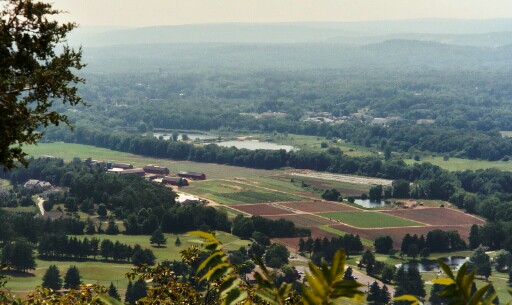
<p>From the trail we enjoyed views of the Farmington River among the tobacco barns and cropland to the southwest, with another traprock range of hills in the far distance:<br />
<img src="http://dougsimpson.com/images/Farmington_SW_Talcott.jpg"><br />
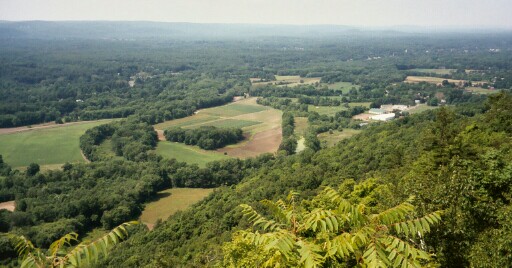
And views to the northwest, where oxbow ponds lined with rows of trees in the foreground give way to the reforested acres of Simsbury, beyond which lie the Litchfield Hills in the northwest corner of the state and the Berkshires in southwestern Massachusetts.<br />
<img src="http://dougsimpson.com/images/Farmington_NW_Talcott.jpg"></p>

<p>This was the vista from which, in 1676, the Indian leader "King Philip" is said to have watched as his warriors <a title="Simsbury, CT History" href="http://www.townofsimsbury.com/history.html">burned Simsbury to the ground</a>. The large cave in the sheer west face of the mountain is known as King Philip's Cave and the ridge, of which Talcott Mountain is a part, the Metacomet Ridge.  The burning of Simsbury was but one incident in the extended conflict between Indian tribes and English colonialists known as "King Philip's War," one of the bloodiest in America's history, ranging from Massachusetts Bay to Rhode Island and Connecticut.  But that's another story: <a title="Amazon.com: Books: King Philip's War: The History and Legacy of America's Forgotten Conflict" href="http://www.amazon.com/exec/obidos/ASIN/0881504831/dougsimpson-20">King Philip's War: The History and Legacy of America's Forgotten Conflict</a>.</p>

<p>DougSimpson.com/river</p>]]>
      
    </content>
  </entry>
  <entry>
    <title>Metacomet Ridge, The &quot;Great Wall&quot;</title>
    <link rel="alternate" type="text/html" href="http://www.dougsimpson.com/river/archives/000055.html" />
    <modified>2005-02-01T16:49:30Z</modified>
    <issued>2003-08-09T07:15:02-05:00</issued>
    <id>tag:www.dougsimpson.com,2003:/river/4.55</id>
    <created>2003-08-09T12:15:02Z</created>
    <summary type="text/plain">Metacomet Ridge, which shapes the flow of the Connecticut River, has been called The Great Wall. It neatly separated the commerce and transportation of Hartford and New Haven with a wall of igneous &quot;traprock&quot; running from Branford, CT to Northhampton,...</summary>
    <author>
      <name>dougsimpson</name>
      <url>dougsimpson.com</url>
      <email>douginhartford@earthlink.net</email>
    </author>
    <dc:subject>Geology</dc:subject>
    <content type="text/html" mode="escaped" xml:lang="en" xml:base="http://www.dougsimpson.com/river/">
      <![CDATA[<p>Metacomet Ridge, which shapes the flow of the Connecticut River, has been called <a title="The Face of Connecticut" href="http://g3.tmsc.org/face_of_ct/22.htm">The Great Wall</a>.  It neatly separated the commerce and transportation of Hartford and New Haven with a wall of igneous "traprock" running from Branford, CT to Northhampton, MA.  </p>

<p>In order for New Haven to partipate in the profitable river traffic between Northhampton and the seaports on Long Island Sound, the <a href="http://www.yale.edu/ynhti/curriculum/units/1981/cthistory/81.ch.04.x.html">Farmington Canal </a>was funded and built between New Haven and Northampton during 1825 to 1835.  It was plauged with problems from the start, and never proved a financial success.  Hartford improved the natural waterway to Northampton with the Enfield Canal built around the shallow water at Windsor in 1829.  But the development of the railroads was the final downfall of the Farmington Canal, of which a few ruins still survive along a <a title="" href="http://www.farmingtoncanal.org/info/trail.htm">Heritage Greenway Park.</a></p>]]>
      
    </content>
  </entry>
  <entry>
    <title>Hobbomock&apos;s Eternal Sleep in Hamden Protects the River</title>
    <link rel="alternate" type="text/html" href="http://www.dougsimpson.com/river/archives/000020.html" />
    <modified>2005-02-01T16:49:30Z</modified>
    <issued>2003-06-15T17:05:47-05:00</issued>
    <id>tag:www.dougsimpson.com,2003:/river/4.20</id>
    <created>2003-06-15T22:05:47Z</created>
    <summary type="text/plain">Thursday turned out to be the day to be safety officer for 6 teens climbing in Sleeping Giant State Park in Hamden, CT. Two miles of mountaintop resembling a sleeping giant give this park its name, and make it a...</summary>
    <author>
      <name>dougsimpson</name>
      <url>dougsimpson.com</url>
      <email>douginhartford@earthlink.net</email>
    </author>
    <dc:subject>Geology</dc:subject>
    <content type="text/html" mode="escaped" xml:lang="en" xml:base="http://www.dougsimpson.com/river/">
      <![CDATA[<p>Thursday turned out to be the day to be safety officer for 6 teens climbing in <a title="Sleeping Giant State Park Information" href="http://dep.state.ct.us/stateparks/parks/sleepinggiant.htm">Sleeping Giant State Park</a> in Hamden, CT.   </p>

<p>Two miles of mountaintop resembling a sleeping giant give this park its name, and make it a distinguishing feature on Connecticut's skyline. <br />
<img src="http://www.sgpa.org/history/giant.jpg"><br />
<a href="http://www.sgpa.org/index.html"></p>

<p>The Sleeping Giant Park Association</a> describes the geologic formation and the native legend connecting it to the geology of the Connecticut River:</p>

<p><i>"The trap rock ridges in Connecticut began life about 170 million years ago when volcanic eruptions formed the columnar patterns of basaltic rock. This hard rock which fractures at near 90 degree angles gives the rock the name trap meaning step or stair in Swedish. In Connecticut most of these ridges run north-south, but one unique ridge six miles north of New Haven runs east-west and has the distinctive profile of a recumbent human, especially when viewed from the south. This Sleeping Giant has held a mythical quality for all who see it. </p>

<p>The Native Americans in the area called the Giant Hobbomock, an evil spirit who became angry at the neglect of his people and stamped his foot near the current location of Middletown causing the Connecticut River to change course. Keitan, a good spirit cast a spell on Hobomock causing him to sleep forever so that he would do no further damage."</i></p>

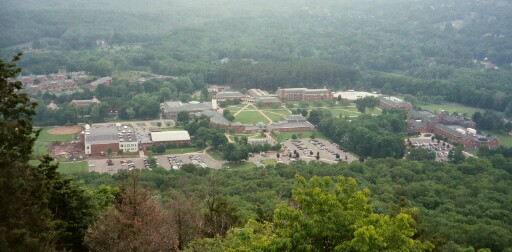
<p>Along the climb, one finds panoramic views of <a title="Quinnipiac University - Degrees in Accounting, Advertising, Biology, Communications, Education & Other Majors" href="http://www.quinnipiac.edu/">Quinnipiac University</a>.<br />
<img src="http://dougsimpson.com/images/Quinnipiac_U.jpg"><br />
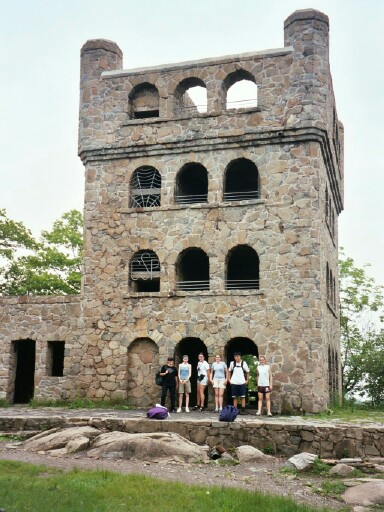
And at the top (accessable via an easy graded fire road built by the WPA) is the 1930's era stone tower built on the high point of the Giant's "left hip" from which one can see Long Island sound and the Giant stretched out all around you.  <img src="http://dougsimpson.com/images/MtCarmelTower.jpg"></p>

<p><br />
DougSimpson.com/river<br />
</p>]]>
      
    </content>
  </entry>
  <entry>
    <title>In the Beginning ... Lake Hitchcock</title>
    <link rel="alternate" type="text/html" href="http://www.dougsimpson.com/river/archives/000015.html" />
    <modified>2005-02-01T16:49:30Z</modified>
    <issued>2003-06-11T05:13:16-05:00</issued>
    <id>tag:www.dougsimpson.com,2003:/river/4.15</id>
    <created>2003-06-11T10:13:16Z</created>
    <summary type="text/plain">Glacial Lake Hitchcock, at places 20 miles wide, stretched from Rocky Hill, CT to Keene, NH 15,000 years ago, then drained, forming the foundation for the modern culture of the Connecticut River Valley</summary>
    <author>
      <name>dougsimpson</name>
      <url>dougsimpson.com</url>
      <email>douginhartford@earthlink.net</email>
    </author>
    <dc:subject>Geology</dc:subject>
    <content type="text/html" mode="escaped" xml:lang="en" xml:base="http://www.dougsimpson.com/river/">
      <![CDATA[<p>Culture is shaped by geology and climate, and few regions have more interesting climatic and geological history than the Connecticut River Valley.  What made this river a center of agriculture, industry and science dates back 15,000 years to the formation of <a title="Glacial Lake Hitchcock" href="http://www.bio.umass.edu/biology/conn.river/hitchcock.html">Glacial Lake Hitchcock</a> .  Lake Hitchcock formed following the retreat of the last ice age, which had covered what is now New England with ice thousands of feet thick. <a href="http://www.yale.edu/ynhti/curriculum/units/1995/5/95.05.01.x.html">Alter, "Geology of Connecticut - Glacial History"</a>  It stretched from Rocky Hill, Connecticut north some 200 miles into Vermont/New Hampshire and was 20 miles wide at points until it drained some 12,000 years ago.  </p>

<p>This lake laid down thick sediments that not only preserved the history of dinosaurs and mastadons and the "armored mud balls" found nowhere else, but also formed the foundation for a rich agricultural and industrial future. <a href="http://www.earthview.pair.com/ctriver.html">Little, Geological History of the Connecticut River Valley</a>  </p>

<p>This weblog is about the cultures that grew in this well-watered valley.</p>

<p>DougSimpson.com/river</p>]]>
      
    </content>
  </entry>

</feed>